Sunday, October 4, 2015

Play Entry 6- "unhappy" play -emotional engagement and the Battle for Zendikar Pre-Release

During this week more than others I have encountered play by participating in it in the dual spaces that are my "fun" and my "work". It is also not surprising in retrospect that is was also impossible to make time for updating this journal.

On Sunday a week ago it was Pre-Release for the newest version of Magic the Gathering - the site through activity that ultimately is the field for my anthropological work. Pre-releases are the ones most geared by the corporation to be welcoming and fun, this is also the beginning of a new attempt to have non-gameplay aspects of the design be communicated and integrated into the design of the gameplay and unified through the other means of communication owned and organized by the corporation.

In previous pre-releases aspects of things that felt/looked-like "play" were pretty high for me from a subjective standpoint - I'm a native participant observer, I always go to pre-release events - its part of my personal habit and tradition and it's one of the places where I feel "safe" to learn and make mistakes - the crowds are different for pre-releases even at my home store.

I was stressing over a paper and writing in general - part of the journal is a self created requirement it's taken effort to write at all since I've returned from the UK. In the stress of sorting my thoughts and figuring out if I could write them at all, I over-produced for the assignment and wrote something different than the expectation - so three days of writing eight pages of a thing that required probably a day of sorting thoughts to write two pages instead. I did not spend those three days playing the game.

I also did not spend any of the time I allocate "for myself" doing any of the things I consider "not work" which I and still not sure is the same as "play"

Things I would normally do would have let me read the fiction that underpins the game release. So I know the outline of the story only from the things prior to the corporate approved ramp -up to pre-release.

In previous pre-releases the game created events that allowed you to self identify and provided tools inside the games themselves. You chose a color, picked a guild, got involved with dragons or clans that were led by distinct personalities - there was a sense of joining AND identity that made me engage with these things whether or not I fully agreed with them - and this is an interesting part - affected me even if I never found a clan. There was emotional investment in NOT finding a space.

So in the Ravnica expansion I ended up identifying with Azorius and being disappointed that it never pulled through on the aspects of what Azorius were that made it appealing to me - but this time 3 years ago my girlfriends and I represented our guilds with pride and spent the year examining whether or not the game design reflected our guilds "fairly" - remember the design team made our guilds in the first place

I would just like to point out that in true Azorius fashion my manicure matched regulatory guild color schemes down to the pantone number.
In the Theros release the colors that make up one of the aspects of game environment were all given "Paths" or philosophies - you chose you colors and used that path to play against a Hydra with a group at the end of the pre-release event. Personal identification with a group was not a part of this play environment but uniting against an entity collaboratively was and the element of choice meant that you also "chose" your play experience. In MtG players frequently identify themselves by something best understood as "core color values"

"I'm mostly a blue mage" means the person speaking to you plays decks and cards that are usually about counterplay and controlling the actions of the board state. "I'm a red mage" means they will play strategies that involve direct damage spells, fast small creatures and then big finishers that are fast. the other three colors also have associated strategies - combining the colors is also strategic but not relevant to this discussion of "play" and identity. What IS important is by choosing a color you are also tilting the chances of being able to participate in the way you most enjoy "playing" the game - these pre-releases are all made from sealed packs and random chance. The cards you get might not support your favorite style of play. That doesn't mean you won't enjoy playing it but it does mean you declare an identity or preference or idea of what you like BEFORE settling on the best deck to build out of your cards.

So this is the idea of Theros - you are the hero - the entire block is based around the Hero's Journey complete with underworld. The color is just one of many tools you might use to be there, the event allowed you (if you wanted to) to participate in a way that allowed you to build your own hero milestones while working with others in the community. I played five events to try each of the colors. I "had fun" and also enjoyed the play based design of this expansion as well. I knew what was going on and felt connected to the art.

Remember this is a journal entry not a formal critique of either game design or the event design - this is my personal experience of "play"

The next pre-release would take place while I was at my first field site environment - "play" meant many things but the event was once again "pick your color" which was tied to specific iconic characters and then had a special "fight against the Big One" element which even if you didn't choose to do it lead to solidifying a sense of "picking a team" and knowing the various main characters were all involved in reaction to this one threat.

Then the next major release used an Ottoman Empire influenced fantasy setting that took 3 colors each - choosing clans based on color was not something I felt very invested in but the art itself and the interpretations of the Ottoman empire cultures as "inspiration points" did create emotional resonances for me and this art in particular:

Rattleclaw Mystic MtG Art by Tyler Jacobson


The reasons are because my family is diasporic from the area represented by this tradition - it's complicated but resonant for me because underneath a lot of our performance of a "mainstream" version of my religion are cultural echoes of something else entirely. It is underneath the way women in my family are raised and even when in opposition or active attempts at assimilation they have survived - little hard define - not-shared-with-outsider-tags. It is now mostly subconscious and I do not discuss it even in-family so when they pop up things are slightly surreal. This is an engagement through play and emotional resonance that it would be impossible for corporation-gamedesigner- artist to intentionally create - it is still part of my "play" during my very, very limited ability to participate in this expansion's season Rattleclaw Mystic is in my mind's eye every time I touch one of the cards from the block. She is "my team" or I am hers. 

There is a slight underpinning of desire to play for her to make her proud or share a connection - it is difficult to define. Because she is single colored as a card but produces mana (color coded "energy" that powers spells as a game mechanic) of other colors she does belong to a clan but I don't think of the clan, I think of her. 

The block ends with Dragons leading the groups of humans and other entities instead of the non-dragon leadership the block starts with. I cannot tell you who any of the dragons are except Slumigar - I remember vaguely enjoying that last pre-release but not caring as much because everything had shifted to a dragon focus. There mechanics ( too detailed to enter here) were the driving force of the game and "gameplay" and in many ways the set felt like it was just setting up the release I missed all the set-up for last Sunday. 

The story I know about this week's game I know because of story information released over the year through other events and outlets. I know because the Magic Origins pre-release (once again focused on iconic characters and "fixing" some issues with their stories made in the past) sets up this release "Battle for Zendikar"

I however don't care about Zendikar. Ultimately possibly because I know little about it as a place other than where a bad story choice happened that undermined the competence of a previously competent female character and then because the primary bad-guys are ubiquitous throughout the set. 

because I could not "play" through my own personal time all I can do is react to the art when I see it and the game play- I am almost never this unknowing when engaged in the launches of the game either as a native or as a "working ethnographer" 

But a significant difference this pre-release was the removal of "choice" from the pre-release game experience. 

A significant improvement in tactile effects was made because the product delivered itself in a usable deck box  - however it did not extend it's usefulness enough to handle being able to hold all of the cards that would be opened in protective sleeves - for outsiders to this culture these next sentences will be almost gibberish:

I pulled a Kiora which would have put me in green/blue but I was unaware of "Devoid" before I opened the packs and also was able to build a very strong red/white allies deck. Once I understood that Devoid meant that colored casting meant colorless cards I could also build an acceptable deck around Kiora. I built two full decks to sideboard Kiora , but led with the allies. 

The problem that will now be understandable whether you play the game or not is that the provided deck box couldn't handle holding 2 fully sleeved 40 card decks. 
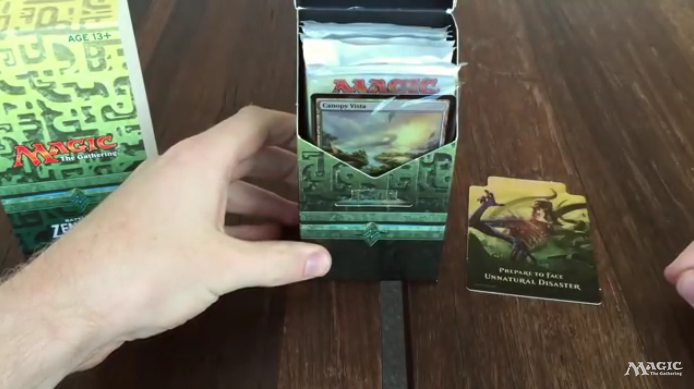
Photo from http://demoneyeslucifer.tumblr.com/post/129428318596/mtg-realm-magic-the-gathering-battle-for

this meant that I could not use the box to hold more than one of the decks at a time - which meant since I didn't bring an outside deck box I was transporting one or the other as "loose cards" between each round. I was now worried about moving of losing the cards. 

What I was also noticing was that I couldn't easily read or differentiate cards being played if they were part of the main theme of the set - the colorless Eldrazi cards or the cards with Devoid" 

Let's take a look at the design choices that lead to that problem:


The cards are too similar in theme and in this search for "Visual Spoiler Battle for Zendikar Eldrazi" the cards that are easily differentiated are from other releases - another problem that happens in this set is that the contrast and lighting on the computer versions being seen is significantly brighter and higher contrast than the printed cards which are fairly muddy in their physical form. 

There is a fill under the text box of Magic cards generally but the fill is a  much MUCH lower percentage on the eldrazi associated cards. 

On the computer version the higher brightness makes it look readable in print, for me - along with the "floating frame that continues the art to the edge of the card giving my eye no symbolic edge to stop "reading" the combination meant that I was hitting right into the things my learning disability needs to compensate for which since it's pretty much just a vision processing thing means I will eventually start having neurological symptoms expressed through physical presentation, vertigo, nausea, a loss of ability to interpret things I don't normally have a problem processing - remember all vision is really just signals to the brain interpreting shape-symbols. When I over-stress that, I can't actually recognize physical objects and things that are normally not affected like "reading english" become affected  because of whatever my brain chemistry does to work around "mixed symbols" 


There's a lot of stuff I already do to read a card - I wish the printed version of this were closer to the color and contrast balance here but frankly it all ended up looking like black and gray jagged mush. 

I recognized the problem that I might have had constructing my own deck with cards like this and chose to "lead with" the clearer and easier to read red/white deck BUT I didn't remember that I would be spending the rest of the day reading my opponent's cards - where without the disability issue I imagine there is less difficulty reading the cards. 

That means I'm subjecting my brain to a kind of slow tapping water torture and fully unaware of it to consciously counteract it. There is a thing called "tilt" where you end up with outsized reactions to small frustration and I was near it by round 4 but finding out there needed to be a round 5 put me over the edge. 

I was nauseous and upset but nothing bad has happened - it was only when in the car and headed home I recognized that "nauseas" felt like vertigo and I was having trouble reading road signs. (I was not driving) and then placed it in it's proper cause and effect. 

The way I normally deal with LD issues is by preparation and exposure to the cards - but I did not have that, nor did I have any emotional connection to the gameplay other than being happy to play Magic again, I did enjoy the first three rounds but my 3rd round opponent was using a lot of the colorless cards and I probably built up tiny "injuries" through the fourth round - that's already 5 hours of "play" and there is an obligation to complete the competition for the "5th" although if I understood what was happening I would have conceded to that player. 

The 4th round though was playing a deck very much like mine and then the description I gave at the time was it "wasn't fun" playing the same deck strategy against "the mirror" which is what we call it when the same basic decks face each other - so the last two games "played" were not "fun" 

But they were "play" 

And since I was there as myself primarily and not on the clock they were my own choice time and definition of "personal play" 

And I will not sugar coat it when I was clear of everything from the physical symptoms about 45 minutes later I was in tears recognizing that if I'm having this much trouble with the cards in this set they are going to be in standard for 2 years and I was fully overwhelmed. 

I had tag neurological symptoms through Monday.  

- but I also realized that I was missing a thing that had gotten me through similar rough patches at other pre-releases - which is emotional engagement in the story - the entire set has a kind of flattened affect for me - everything is gray and dreary, I did not play in the first visit to the plane so I have no nostalgia factor that makes me care about the creature based art and there are very few groups or entities represented in the art of the cards that made me care about them as characters or people. I literally have no engagement with them- most of the anthropomorphic characters are viewed a middle distance and the art is lovely but the card art shows them at approx. 2.25 x1.5 inches for the most part.

If I "care" about the story or the things represented by the cards more does that element of connection/kinship/identity/choice  help me reduce the side effects of the neurological work? Or does that level of engagement simply create "play" effects that counteract negative physical effects. 

Maybe it is something along the lines of this - if the element of connection/kinship/identity/choice I am engaging with the visual and physical components using MORE than the visual stimuli and attendant processes - so like using multimedia input "engaged play" might be using different neural connections than "mechanical play" which would be how I experienced this pre-release as opposed to the previous ones. 

I am an outlier player - I am sure some of my experiences were experienced by other players but would have lower physical effects or (as I almost did myself) be written off as being "in a bad mood" or "not liking the set" but they may well be that limiting modes of "playful" interactions puts more impact on "play" as function. 

I was cranky through Monday where and element of working was then fully suffused in "play" and I realized later "broke" through the effects of the previous day's play. That will be the subject of the next entry - this was a  long and complicated week for work/play. 

End reflection: After playing again this weekend and protecting the areas that would be affected by the unique aspects of the new cards "playing for fun" was not effecting me negatively but I still only "had fun" helping others have an opportunity to play - I am still not engaged positively with the set and worse I don't even really remember any of the cards I played with or handled. 

I don't feel like "play" should only be justified through positive neurological or cognitive effects but due to this self-examination I am wondering about how much "fun" might be involved in play and what happens when this nebulous thing is or isn't present. Can it be created? Is it individual? 

Am I only "performing play" if a thing I enjoy is actively causing me distress? what is play then? 

Friday, October 2, 2015

Play Entry 5

"Now that hosiery is no longer quite so compulsory, it has been refashioned as a site of play. The browser confronts a carnival of decorative possibilities: jubilations of patterned tights and dainty plays of dots, embroidery suggesting the avant-­garde compromise of a tea cozy and a temporary tattoo. There are mass-­market numbers apparently engineered to adjust to body temperature and most definitely embellished with crystals, and there are high-end fishnets constructed with an understanding of the millimetric nuances in flirtiness. "

http://www.nytimes.com/2015/10/04/magazine/the-politics-of-pantyhose.html?WT.mc_id=2015-OCTOBER-FB-MC9-AUD_DEV-1001-1031&WT.mc_ev=click&ad-keywords=AUDDEVREMARK


Saturday, September 26, 2015

Anthropological Thinking about My Own Methodology

If the work of Frans Boas is still considered preservationist the idea is that it would describe something theoretically static before it disappears.

There is good reason for that fear. The Settler Project was ongoing and the South was beginning to win the peace during restoration. "record it before white european expansion kills or assimilates it" and not be completely sure what you're saving makes sense. But then there is the reality of what that work did.


  • It preserved lines of thought and activist argument agains those thoughts of white academia/society
  • It recorded (by accident?) the impacts of cross cultural exchange and asymmetric power systems
  • It created (a fractured) place for those communities to go back to when they stubbornly survived in the face of active physical and cultural genocide thus allowing them to "read back" and reclaim their languages and their spiritual practices
  •            - It also created the problem of making those initial reclaiming something interrupted instead of living practice that would have grown and changed over time. 
  • It "preserved" image, practice and interpreted thought and played into ideas of "authenticity" 
  • It upholds the destruction of sovereignty of occupied cultures by allowing for the idea that the "one drop rule" can be applied to First Nations and Native American groups for "recognition and membership" that is fully determined only by their occupiers. 
  • It created a reality where many of those groups have adopted that criteria to protect themselves reifying the social construct of race where there were government-states-cultures before. 
What I think about and care about is cultures of activity - with the idea that these cultures are specifically joined positions of choice. The work that I need to do looks more like the work of Boas and Malinowski - initially descriptive. Thus preservationist. 

But I am a designer/project manager/ops director/incipient anthropologist- and that work doesn't look like "preservation" to my eyes or in the context of the work that is later built on it or it's long term effects. It looks like "baseline" and then  becomes the thing against which you CAN track change, or do needs assessments, or enter into conversation cross culturally - the commonalities that underpin "evolution" theories in 19th century anthropology are less artifacts of universal cognition generation culture to me than point of commonality that would allow different culture to have moments of shared cognition and therefore possibly "equalized" communication. 

So the methodology I want is baseline with the knowledge that it is an artifact of sharing and change as opposed to an artifact of preservation. 


Like Boas but ASSUMING dialogue and change - and since it will be longitudinal recording change as it happens during the study.

There are small study/documents like that in my previous working spaces - when I was a stage manager that was what the "God Book" was, When I was a designer that's what the style book could be (some places treat it as a living document - others as a final baseline to control output), when I was a project manager I kept a project book that in retrospect was just a highly structured God Book.

The thing all those documents ( though smaller in scale/scope/purpose) have in common is that they are all looked at as beginnings not ends, and checkpoints - so controls not static points preservation. They were living documents that record their "changes from".

Multiple people contribute to them - they were always meant to be multi-use by the community of humans using them - they were (and I suppose in anthropology this is the part that needs serious ethical thought) sharable centralizing artifacts.

They are accessible to outsiders, audits and reviews even though the high-use group will have and see things in them that outsiders will not. They are written for multiple simultaneous audience.

If I treat my target cultures of activity like Boas and Malinowski what would a similar document I create at the end be called if its considered an act of beginning instead of a capstone of ending?

 - and at this point we need to be real about what I care about:

Workspaces - mostly focused on Tech/Science,
Communities of "leisure" until I come up with a better definition, and communities of
Performance ( Dance - Ballet specifically & Theater as an Insider)
Human Interaction ( Computer-Human Interaction specifically)

And I need to be real about why I care about them:

Based on the work of
Joseph Henrich
Department of Psychology and Department of Economics, University of British
Columbia, Vancouver V6T 1Z4, Canada
joseph.henrich@gmail.com
http://www.psych.ubc.ca/!henrich/home.html

Steven J. Heine
Department of Psychology, University of British Columbia, Vancouver
V6T 1Z4, Canada
heine@psych.ubc.ca

Ara Norenzayan
Department of Psychology, University of British Columbia, Vancouver
V6T 1Z4, Canada


ara@psych.ubc.ca

I believe that we are indicating that culture creates cognition in a physical way - which means for WEIRD ( Western Educated Industrialized Rich Democratic) cultures that are incorporating computers into everyday use are creating not just Ubiquitous Computing  a concept developed by Genevieve Bell and Paul Dourish but circumstances where we could look at "Computers as Environment".

If things being thought about in those two works are working the way I think they are when you look at the mythology around the tech industry and it's application to who they think is doing work, how that work is presented, and then who is actually constructing the ubiquitous computing that becomes transparent to the user becomes very important - culture creates cognition, designers and tech workers are acculturated - computing is ubiquitous to the point interface is unthinking/invisible "natural" transparent- the things they make will reify cultural factors in a literal/physical sense - those programmers will literally create the cognitive environment - most of them will not be thinking about it. They are not all "young disruptive wizards" they are workers - their identity will not be engaged in the space where they are "thinking about" some of these things unless thinking about these things becomes a part of the culture.

( *thank you Volkswagen for giving me a quickly grokable example of why you are operating a mobile computer and not "driving a car").

But to know what they ARE thinking about and how it affects things you have to know what that culture is now, and the history of how it got that way and how it affects the cultural realities and Durkheiman social facts it creates and that it is created by. AND THEN you have to look at how it was changing while you were looking - and record it while all the ops managers are trying to use culture as commodity and "change or manipulate culutre" in their environments.

I have not read an ethnography where I didn't see that it was actually recording change instead of "preserving" things considered "authentic" regardless of the intent or positionality of the author or cultural group.

I have very specific questions I want to ask about the activity of tech as creators and users and I thought I would learn this thing I think of as "Baseline Study" in undergrad and then future research would be answering those questions.

I still have those questions and now I have a better understanding of why there isn't this kind of methodology I'm thinking of but I haven't shaken needing it and needing it to be sharable across stakeholders - and many of the stakeholders wouldn't be academics.

And that leaves me where I am - I want to run longitudinal cultural studies on cultures of activity, I want them to look a lot like Boasian preservationist studies, but they won't be preservationist or activist so I need to figure out what they are instead.

My Independent Study discussion group right now labels anything where my project management background colors my discussion of theory of methodology "Adrienneist" until I narrow it down.

It's a dialogue really or maybe more of a methodological cocktail party -

Friday, September 25, 2015

Play Entry 4

This article claims "play" but none of the activities described are play except the "play parachute" which sounds like a structured activity with rules and songs.

Are the children and seniors allowed to "Just Play" would anyone consider just leaving them in the room together for four hours and sit at the sides to see what would happened.

This is mediated contact with seven or eight goals that sound like they were there to get funding.

There is nothing wrong with this but the question becomes why is it even considered to be used in the context of "play"

Who are they using that word for - what work is it doing by disguising the fact that it is fixing broken social systems under a number of "acceptable" goals

"Seniors and children at play: Homeschooling program mends the generation gap"

They are not at play - they are in supervised educational and health environments with all their actions serving either the goals of the state or correction of the collateral damage by the culture. 

Is it only "play" because children are involved and not being evaluated and scored? 


Play Entry 3

Yesterday we watched Margret Mead's Balinese trance dancers and the class ( which was a theory class)was asked to react.

The distress of trance dancers in the context of words provided by Margaret Mead is out in relation to the fact that this is a performance, and complicated further by the reality that it is a commissioned performance. It is a ritual "play" and it took one of the students some work to realize that her assumptions about reality or unreality of Performance vs Ritual were actually western constructs she was applying to something she viewed to sort out her feelings about the film.

Here is a thing - she immediately discounted her initial reaction as "not useful" and I was thrilled that the prof gently led the discussion back to not discounting the "usefulness" of your own reactions and process.

Things don't automatically hit binaries of useful/useless.

My own reaction was this - Here is a merging of states and play interaction - the men have western appearing haircuts and facial hair for this dance. It is in 1939 The Dutch have been there since 1908 - it makes me wonder about the interplay of local/cultural at that time.

There is that word "inter-play"

This is an article on the Mead's use of visual anthropology and some of the questions that arise from it http://coolstudios.com/576/pdf/jacknis_mead_bateson13pp.pdf

But here is the thing I am thinking - the form of "ritual" or dance being filmed was actually created within two years of it being filmed. The presence of female dancers was recent and new - treating it as a current-to-itself performance within its own cultural context is not out of the question- it had to be developed, practiced, given meaning, and ultimately performed.

There is the work of it - but the words performance/calling it a "play" move some western viewers into a space where they have to think of it as equivalent to "fake" or "unreal" or "inauthentic"

The modern viewer associates though acculturation the idea ( made stronger through style, technology and time displacement) that they are watching an "inauthentic" (whatever that means) version of an older cultural artifact when I think what they might be watching is a HIGHLY "authentic" cultural product of experimentation and exploration of ritual space and cultural relation with the anthropologists.

No one calls an opera "inauthentic" because it happens to be an opera. But operas are not considered "plays" and no one uses "play language" when discussing them. So unreality gets handled differently with opera

what about hyper-reality - could opera and video games have more in common than video games and "play" ?

Also I'm going to come back to this http://www.pccy.org/initiatives/school-play/

and a conversation about block printing vs cursive and concepts of "being an adult"

Wednesday, September 23, 2015

Play Entry 2 - after religious observance.

Today was my observance of Yom Kipper - during the day there were no references to play but that is because my current method of addressing the religious/spiritual requirements is solitary and I only participate in group prayer at the end.

One of the things that struck me was play in it's absence individually and then watching children who had been caught in 24 hours of deep adult engagement with organinzations/kinship and spirituality interact.

Their play was mostly physical spinning and kicking and making games that led to more and more uncoordinated movements. We don't drive and they had to walk home - the words of one child to the mother were extremely oppositional but there was a sense of play and also a sense of using play for "cover" to paste over an existing dynamic and power struggle. Another child used no words but kept the extreme hyper physicality and lack of coordination while also consistently doing the opposite of what was being asked.

They were in things coded play but they experienced no release. The adults had fasted 24 hours and experienced many complicated social interactions and will most likely be reacting inside their own family expectations and psychodynamics but I am left with the observation:

The physicality of the child created play absorbed energy from the adults who had strained theirs through ritual and personal acts during the day. The energy used in their play was reciprocal and generative of more energy - it still coded as "play" when the interaction stopped being something I would have defined as play or "playful" and the reason was the child knew they were inverting the power dynamic - I was the only non-family member present in the room - there was still an element of performance and challenging my authority as an adult - it was not play - play was hastily added on at the end but it was performance based on observing my reaction. It was a tactic.

But there is tactical play.

I need to think about this.

Tuesday, September 22, 2015

Play Entry 1

The journaling thing is interesting because  it's going to force me to think in my own terms of play and work and why I am here at all.

One of the things about the Myers-Briggs system is that I was introduced to it by outsider business people - I mention them because they are like outsider artists and they interact with tools business while holding themselves outside it.

The Fantek organization was heavily devoted to play when all forms of play were considered things to be put aside. The 80's to me in retrospect looks like what happens when people make a number of huge mistakes in college and then spend the rest of their lives pretending that never happened.

It coincides for me with my move from city to suburb. Suburbs do not actually have spaces for play because their children don't leave unsupervised - I used to try to go to the park but there were never any kids there- the teens that would show up at dusk and be chased away by dark would be involved in something considered "loitering" but for them might be considered play.

So that's a thing - there'll be more of this here. My other independent study is an auto-ethnography - we started scoping it out yesterday and the focus is on interaction with computer science - but all of that  work is buried under or made of play.

I worked on fringes of "real jobs" in unreal spaces or had real jobs in fringe spaces before I moved into things that are more easily read - this brings us back to Myers Briggs,

The various places that engage with it treated it like children treat games not like businesses use game. It was a code, a secret that could help people say "the right thing" if they could figure out which type the other person was. It was before autism gave a name to many participants of outsider cultures in arts and science. They were proud of their letters and when getting you to interact with it made them appealing using playful means.

My original test brought me to ENFP - and the joke was that all the successful ENFPs ended up being charismatic dictators - but the other currency was rarity - just like in my collectible card game field work.

The primacy of "T" was very high in this supposed space of "fun" in science fiction convention organization.  "F" was called out for being powerful and discussed as being culturally dominant but it was patently untrue in practice - however "f" plus "t"tendencies was a prized combo. This is because it meant someone might be able to talk to both sides.

That environment used Myers Briggs like a language - theoretically that space was dedicated to the creation and consumption of fantasy. In practice it reified primacy of quantification and engineering but it was poor, aspirational and composed of a strong line of Appalachian families that had suburbanized looking for survival and work. Science fiction was not an "escape" but an actual building of a home culture.

****
Different thought
"Actors are people who were so good at playing Pretend when they were kids, they went Pro" - David White - Acting Prof at Montco.

I was an actor first- I miss the work of it so hard that every time I go back to touch it intentionally it hurts like I've been punched - this is not "play" but the product "puts on a a play".

*******
During the class last week one of our business minded classmates was going over a definition that she disagreed with only one word which was "fantasy" - "I'm very reality based" it was automated - we are at a school that interacts with it's resemblance to a fantasy novel in very direct ways.

******
Discussion during a different meeting environment discussion the culture of a dorm. "Its where LARPing is going to happen on the lawns which is great if Live Action Role-playing is your thing but if you were looking to be in a pro-social space it will be disruptive to the pro-social person and the culture of that space"

The assumption there is that the culture that creates LARPs is different and not-pro social compared to the dorm with the reputation for a culture that puts primacy on queerness and parties. Parties in this case would include dance/drink/romantic opportunity. LARPS are play - the speaker doesn't LARP.

In that construction play isn't pro-social.

*********
I am playing with my class construction like lego blocks in my publisher's house.

********
We throw teas - I am the anthro senior rep - the teas involve an element of play through theme - they are a recruitment tool - I am trained for throwing out ideas quickly - "most of the time between anthro and Halloween we end up with things involving skeletons," she said, indicating that she has saved items to be reused over the years

Me: "We could do Victorian Skeleton Tea parties and honor both the cultural and the physical"

Her: "I'm not sure how you could pull that off" but I can supplement that from my closet at home: temporally based transient events with food are my medium for outsider art - this is easy and it is "play" where I take and expected thing and "play with it" until it becomes a thing that entertains others and meets a goal/need but also entertains me.

*******
Because of Myers Briggs and Quiet ( which I continue to find problematic) I am thinking about where my energy is coming from - writing in a way in which is thinking is happening at odd inconvienient times (4 am on the train before my stop) - small groups and conversations are happening which are energizing, but the recharging is happening, not just alone, but not often enough. However "energy generation" is happening when I interact with someone's structure and work to alter it into something else that is where the amusement is happening - that is where the self part is happening and that is where the "joy" is that is play. It happened in a meeting too - there is too much aspect of the trickster (cultural anthropological category)  in all of my interactions with systems - the trickster builds things and needed a category because it also destroy and white male western culture didn't have a corollary so they built one.

It was the Anthropology of tricksters class that "grounded" me in UN-grounding me and freed me to be able to do my work without apologizing for being a person outside the margins. Or even being a person here.

Is the Trickster play? Is my own play only "joyful" when I get to "play" with other peoples rules to make them do things they weren't built for? or maybe they were built for them and the "play" is to get them back to what their designer wanted instead of how they warped.

I'm playing when I look at a rule, every rule - rules are toys - even my own.